
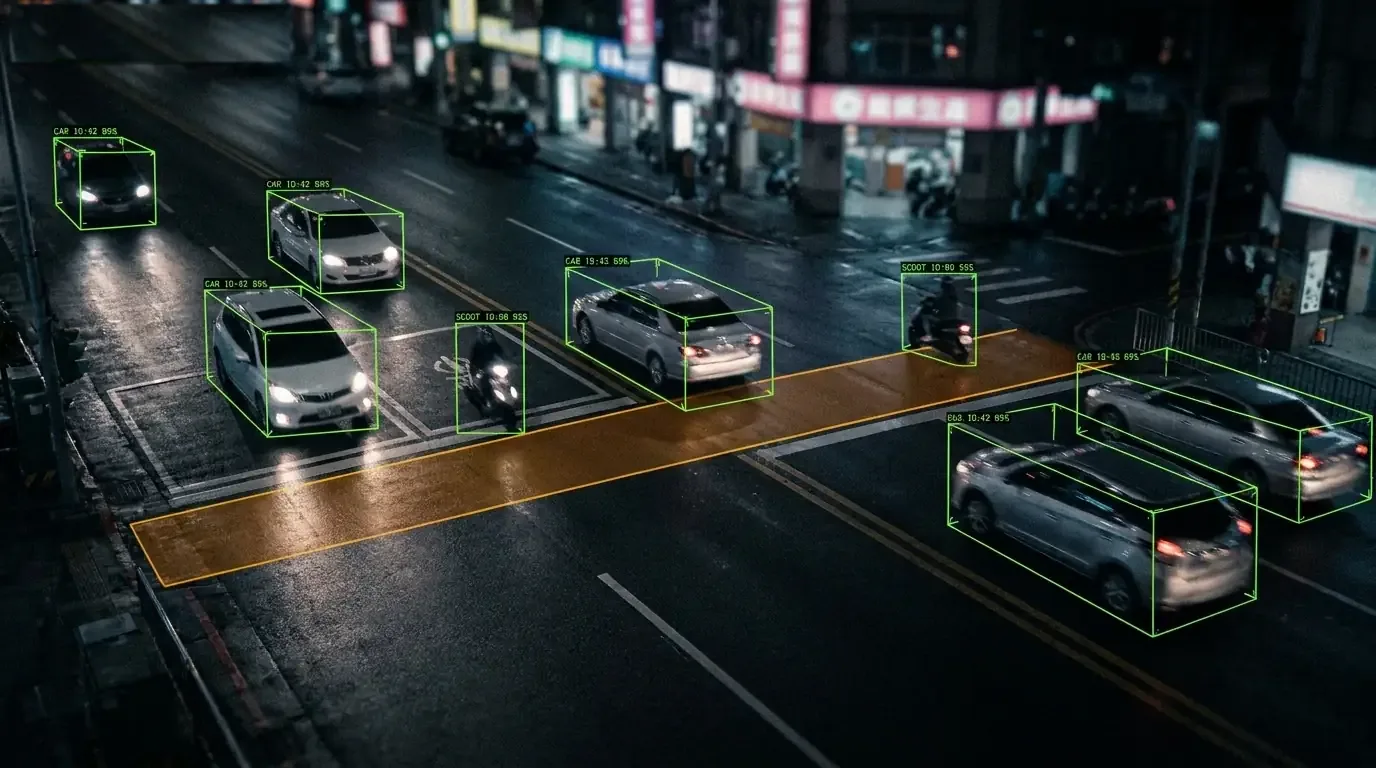
Live Traffic Betting: Seven City Feeds Running Round the Clock
Live traffic betting runs on road cameras that never shut down — this page shows which of the seven is busy in your own time zone.
18+ Independent site, affiliate links
Seven citiesRound ≈ 55 sBroadcast 24/7
24/7the feeds never closeone of them is always busy
Live traffic betting runs on real camera feeds broadcast 24/7 from the studio of 155 Media Studios, with seven cities in rotation: Tokyo, Lyon, Sydney, London, Paris, Bucharest and Bangkok. Because the feeds sit in different time zones, there is always a busy camera and always a quiet one. Stream delay gives nobody an advantage: each round's outcome is committed as a SHA-256 hash before betting closes, so there is nothing in the picture to read ahead.
What runs around the clock
Six lines about the round-the-clock side of the format, taken from the studio's own published material and checked on 21 September 2026.
- Broadcast mode
- 24/7, no schedule
- Feeds in rotation
- Seven cities
- Where it comes from
- 155 Media Studios' own studio
- New round-the-clock titles
- Added monthly
- Round length
- ≈ 55 s
- Result committed
- SHA-256, before betting closes
What "live" means here
Nobody presents the round. There is no table, no host and no studio floor between you and the number.
There is no fixture, no half time and no official scoreboard to wait for. The street does not play to a timetable.
A public road, filmed as it happens, with a zone drawn across the lanes and a machine counting what crosses it.
The word carries a lot of baggage from other products, so it is worth being blunt about what it means on this format. The event is unstaged: drivers on a real street have no idea a market is open on them, and no one on the operator side can slow the road down, speed it up or call for another take. That is the whole claim behind the word, and it is a narrow one.
The consequence is the schedule, or rather the absence of one. A dealer needs shifts and a match needs a kick-off, but a road only needs daylight and people with somewhere to be — so the cameras stay on and rounds keep opening at roughly one a minute, all night included. If you want the mechanics underneath all of this, they are set out in the traffic betting basics on the front page.
Seven feeds and your time zone
Tokyo, Lyon, Sydney, London, Paris, Bucharest and Bangkok run on their own clocks, not on yours. A city street has a rhythm anybody can name: it fills in the morning as people travel to work, thins out at midday, fills again in the early evening and empties overnight. Seven cities means seven copies of that rhythm, offset by their time zones.
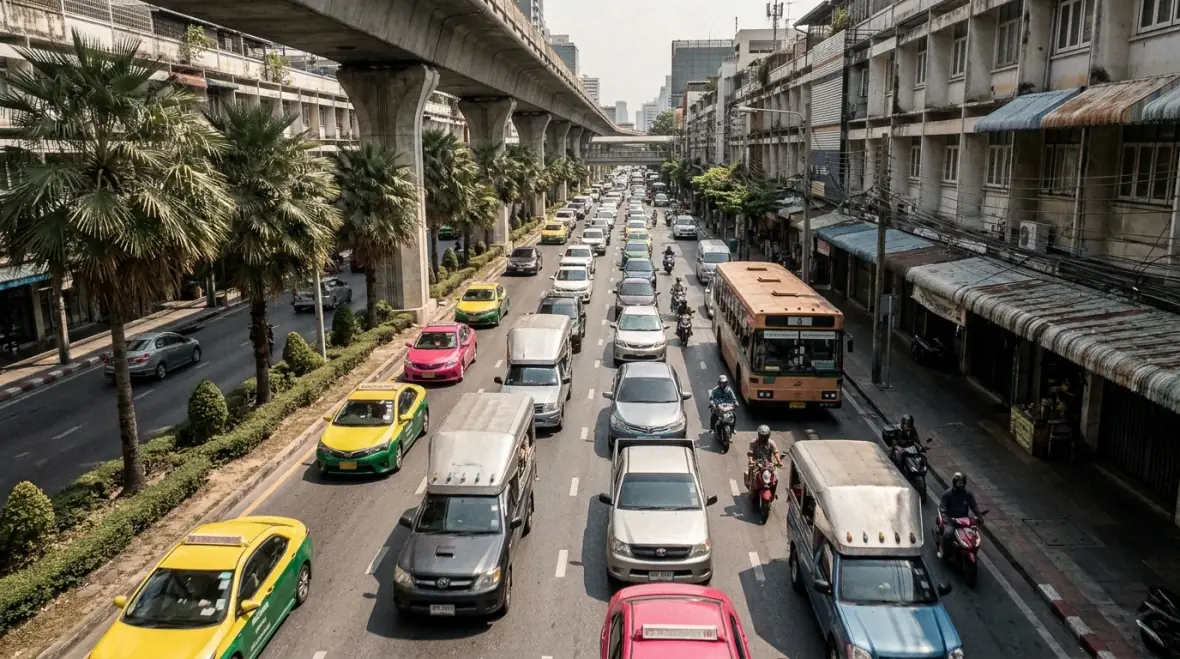
The board reads your browser's time zone and sorts the seven feeds by distance to a rush window. Each is marked RUSH, STEADY or QUIET against its own clock.
Your clock --:--browser time zone
-
 TokyoPeaks 07-09, 17-19 --:--—
 -
 LyonPeaks 07-09, 17-19 --:--—
 -
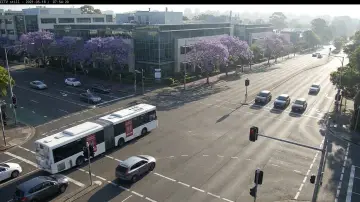 SydneyPeaks 07-09, 17-19 --:--—
 -
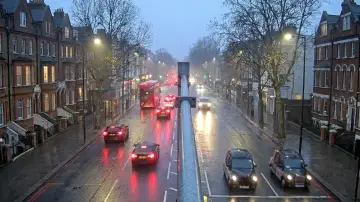 LondonPeaks 07-09, 17-19 --:--—
 -
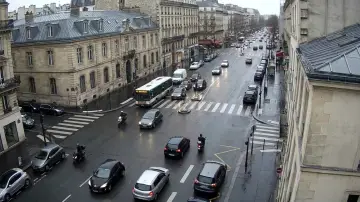 ParisPeaks 07-09, 17-19 --:--—
 -
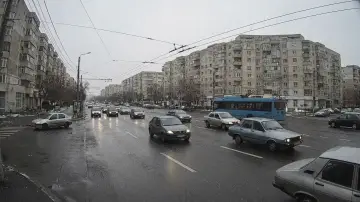 BucharestPeaks 07-09, 17-19 --:--—
 -
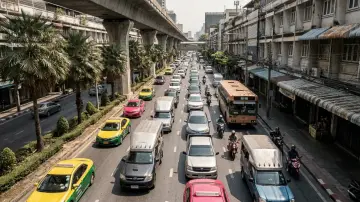 BangkokPeaks 07-09, 17-19 --:--—
Nothing is fetched from a server and no feed is predicted: the arithmetic is your clock, seven fixed offsets and two peak windows, 07:00–09:00 and 17:00–19:00 local. At three in the morning in Europe the cameras with traffic on them are Sydney, Tokyo and Bangkok; at three in the afternoon the eastern feeds have gone dark and empty.
Use it for scheduling, not for selection. A busy feed is not a better bet — it produces bigger counts, and the posted line moves up with them. What the board saves is the quarter of an hour spent watching an empty street.
Stream delay is not an edge
Every stream arrives late. Encoding, buffering and the last stretch of network add up to a few seconds between a car passing the zone and that car appearing on your screen, and the figure differs from one connection to the next. It is a property of broadcasting, and it raises the obvious question: if the picture is behind reality, can somebody closer to the source bet on what has already happened?
- 01Commit The hash of the round outcome is published while betting is still open.
- 02Close Betting shuts down before the counting window has finished running.
- 03Window The camera keeps streaming for the rest of the roughly 55 seconds.
- 04Reveal The seed comes out with the settled count, and anyone can recompute it.

The answer is no, and the reason is sequence rather than politeness. The outcome is committed as a SHA-256 hash while betting is still open, so by the time the market shuts, the result is already fixed in a published string. Studying the picture frame by frame cannot uncover it, because the picture is not where the commitment lives. It works in reverse too: nobody behind the feed can adjust a round after seeing how the traffic went.
Two people on two continents watching the same feed with different lag are betting into the same closed market. Delay makes the format feel less immediate; it does not make it beatable.
Live footage against RNG maths
In a slot or a crash curve, the outcome is drawn by a random number generator and the animation is a way of showing you a decision that has already been taken. Nothing on screen is an event; it is a rendering. On a camera feed the order is reversed — the event happens first, on a street with strangers on it, and the cryptography only pins that event down in advance so it cannot be edited afterwards.
A number is drawn, then drawn again for the next round. The sequence has no memory and no physical cause.
Traffic produces the number. It has causes — the hour, the weather, a lorry in the wrong lane — but none of them are readable in advance.
That difference is real, and it is worth less than it sounds. Causes you cannot observe are indistinguishable from randomness at the moment you place a bet. The honest version of the claim is that the event is verifiable, not that it is predictable.
And verifiability is not value. The published return band for Rush Hour is 90.00–92.16 %, a band rather than one number because it depends on which of the four markets you take. That band is the price of sitting in front of the feed, and a transparent event does not reduce it. The markets and the band are set out in full under markets, RTP and feeds.
What live does not change
- 01The margin A published 90.00–92.16 % return is a long-run loss of roughly eight to ten units in every hundred staked, camera or no camera.
- 02The speed A round lasts about 55 seconds, so roughly 65 of them fit into an hour of continuous play.
- 03The unpredictability Real traffic is under no obligation to repeat itself, and nothing in a past hour commits the next one.
The third point is where the format collects its folklore. A feed that paid out three times in a row gets called generous, a camera that ran dry gets called cold, and both descriptions are about something that has already finished. There is no mechanism connecting one round to the next: the traffic that produced a high count has driven away, and the road starts the next window with whatever happens to be approaching. What does carry over is the camera — angle, lanes, light: see what the zone counts and misses.
The second point is the one that empties accounts. Round length is the multiplier on everything else, because a margin only gets to work when it is applied often enough — and at a minute a round, all night if you let it, that is exactly what happens. The arithmetic of session length is set out in what round speed does to a bankroll.
FAQ
What is live traffic betting?
Betting on how many vehicles cross a detection zone on a camera that is streaming right now. 155 Media Studios broadcasts the feeds around the clock from its own studio, with seven cities in rotation, so a round is always about to open on one of them.
Which feed is busiest at night in Europe?
Sydney, Tokyo and Bangkok sit far enough east that their daytime traffic covers European night hours. The board on this page converts each local peak into your own clock, so you can see which camera is in a rush window without doing the arithmetic yourself.
Does stream delay let someone bet early?
No. The round result is committed as a SHA-256 hash before betting closes, so no amount of watching the picture reveals it in advance — for anyone. A delayed frame is the same delayed frame for every player sitting in front of that feed.
Is a live camera feed better value than a slot?
It is more transparent about the event, not more generous. The published return band for Rush Hour is 90.00–92.16 %, and transparency does not move that number. What the format buys you is a result you can recheck afterwards, not a cheaper bet.
Can I use a busy feed to win more often?
A busier camera produces higher counts, and the posted line moves up with them. More traffic means bigger numbers, not better odds: the same margin sits in the price on a jammed avenue at six in the evening and on an empty street at four in the morning.
Who this page is for
You want to know when to look, and you would rather open a camera in its rush window than at four in the morning.
You want the feed that pays. No such feed exists, and any page claiming otherwise is describing yesterday.
Availability differs by lobby and by country, so check the operators with the live feed before you plan an evening around one particular camera.
18+. A format with no closing time is its own risk: there is always another round, and long sessions are where a 90.00–92.16 % return does its damage. Set a time limit as well as a deposit limit before you open a feed — see responsible gambling or BeGambleAware.